


Page 31 - 7. FINAL draft Compendium 2019 2020_22072022
P. 31
DENTAL PLAQUE MATURITY, CARIOGENIC FOOD FREQUENCY AND ANTHROPOMETRIC
            ASSESSMENT OF CHILDREN WITH LEARNING DISABILITIES IN KELANTAN
            NMRR-17-706-35129

            Rosnani N, Ruhaya H, Normastura AR

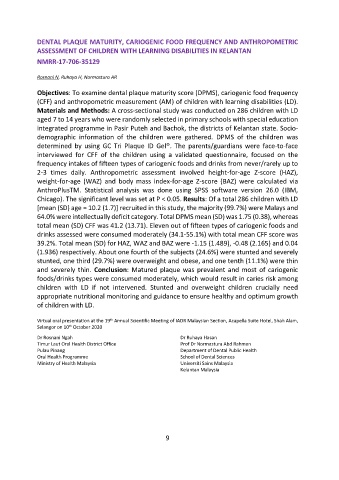
            Objectives: To examine dental plaque maturity score (DPMS), cariogenic food frequency
            (CFF) and anthropometric measurement (AM) of children with learning disabilities (LD).
            Materials and Methods: A cross-sectional study was conducted on 286 children with LD
            aged 7 to 14 years who were randomly selected in primary schools with special education
            integrated programme in Pasir Puteh and Bachok, the districts of Kelantan state. Socio-
            demographic information  of the children  were gathered. DPMS of the  children was
            determined  by using GC  Tri Plaque ID Gel®. The parents/guardians  were face-to-face
            interviewed for CFF of  the children using a validated questionnaire, focused on the
            frequency intakes of fifteen types of cariogenic foods and drinks from never/rarely up to
            2-3 times daily. Anthropometric assessment involved height-for-age Z-score (HAZ),
            weight-for-age (WAZ) and body  mass index-for-age Z-score  (BAZ) were calculated via
            AnthroPlusTM.  Statistical  analysis  was  done  using  SPSS  software  version 26.0  (IBM,
            Chicago). The significant level was set at P < 0.05. Results: Of a total 286 children with LD
            [mean (SD) age = 10.2 (1.7)] recruited in this study, the majority (99.7%) were Malays and
            64.0% were intellectually deficit category. Total DPMS mean (SD) was 1.75 (0.38), whereas
            total mean (SD) CFF was 41.2 (13.71). Eleven out of fifteen types of cariogenic foods and
            drinks assessed were consumed moderately (34.1-55.1%) with total mean CFF score was
            39.2%. Total mean (SD) for HAZ, WAZ and BAZ were -1.15 (1.489), -0.48 (2.165) and 0.04
            (1.936) respectively. About one fourth of the subjects (24.6%) were stunted and severely
            stunted, one third (29.7%) were overweight and obese, and one tenth (11.1%) were thin
            and  severely thin.  Conclusion: Matured  plaque was prevalent  and most  of  cariogenic
            foods/drinks types were consumed moderately, which would result in caries risk among
            children with  LD if not intervened. Stunted and  overweight children  crucially need
            appropriate nutritional monitoring and guidance to ensure healthy and optimum growth
            of children with LD.

                                   th
            Virtual oral presentation at the 19  Annual Scientific Meeting of IADR Malaysian Section, Acapella Suite Hotel, Shah Alam,
                      th
            Selangor on 10  October 2020
            Dr Rosnani Ngah                             Dr Ruhaya Hasan
            Timur Laut Oral Health District Office      Prof Dr Normastura Abd Rahman
            Pulau Pinang                                Department of Dental Public Health
            Oral Health Programme                       School of Dental Sciences
            Ministry of Health Malaysia                 Universiti Sains Malaysia
                                                        Kelantan Malaysia


                                                   9

